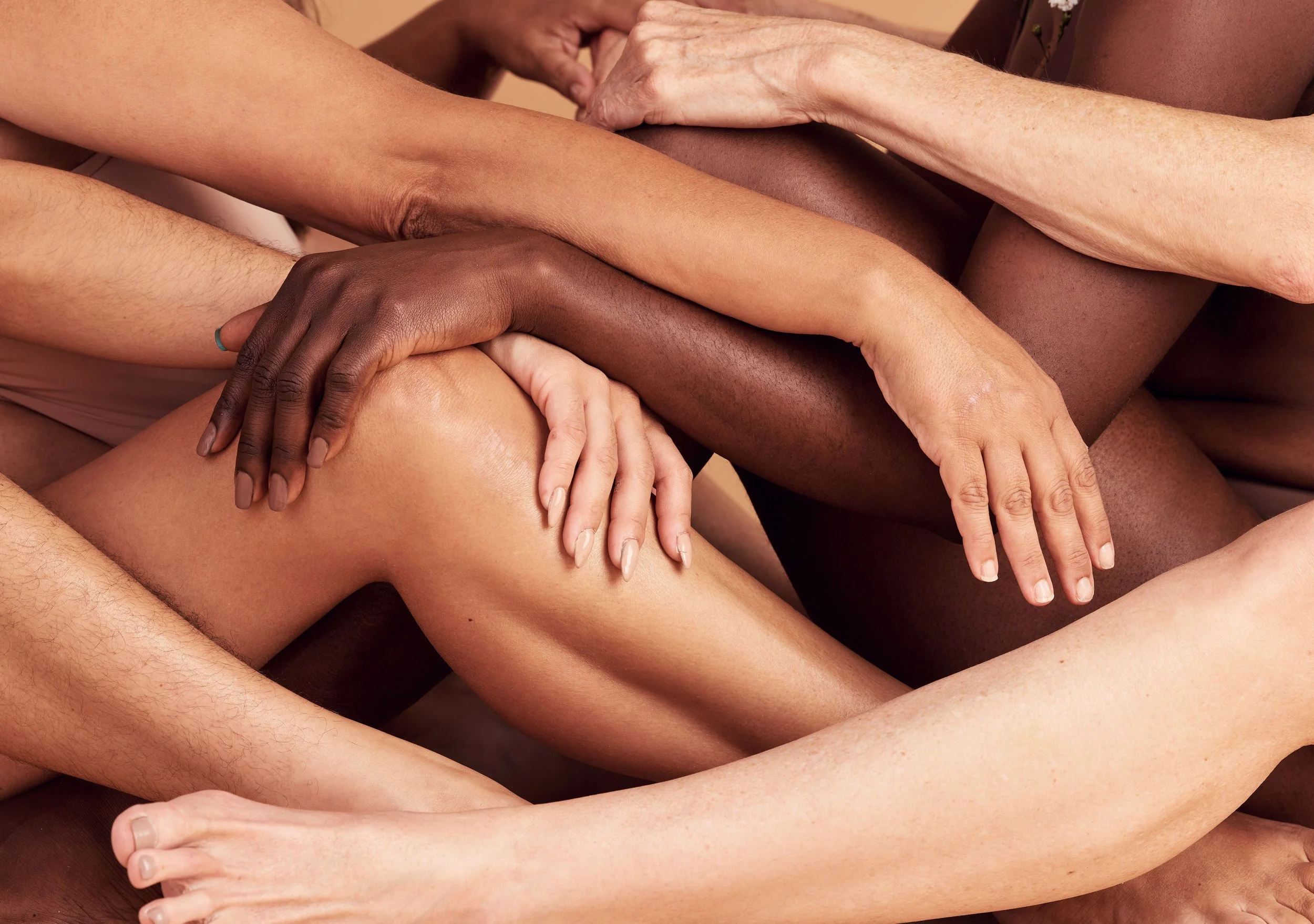
ALL BODIES ARE GOOD BODIES
A Health at Every Size Approach
At Annie Beth Company, I operate from an Anti-Diet, Intuitive Eating, Health at Every Size (HAES), and social justice lens. I believe that ALL bodies are good bodies and that ALL bodies are worthy of love and respect. In addition, I believe that empowered humans create empowered communities. Empowered humans produce change in the world. Thus, everything I do at Annie Beth Company is centered around helping people to break free from systems of oppression, which most certainly includes diet culture.
WHAT IS DIET CULTURE?
Diet Culture encompasses more than just low-calorie, crash diets and sketchy supplements. Diet culture is an IDEOLOGY. It is a SYSTEM OF BELIEF. Diet culture is the belief that thinner equals healthier, happier, and more successful in life. It is the system of belief that upholds WEIGHT STIGMA and the WEIGHT LOSS INDUSTRY.
With that said, diet culture can be sneaky, especially since diet culture KNOWS that dieting is “out.” Consequently, diet culture has gotten really good at disguising itself as “not a diet,” while still keeping you trapped in the endless pursuit of thinness and the endless obsession over food and “hEaLth,” (which by the way is NOT a number on the scale).
So, here are a few ways that you can identify diet culture, even when it doesn’t want to be seen:
Diet culture upholds thinness as a marker of health and moral value
Diet culture blames weight and/or the “ob*sity epidemic” for health conditions
Diet culture depicts certain foods/macronutrients as “good” and others as “bad”
Diet culture promotes the usage of external trackers rather than internal cues
Diet culture promises improved confidence and/or body image as a result of weight loss
Diet culture promotes exercise as a means to lose weight and/or to alter your body shape/size
Diet culture sets strict rules surrounding when, what, and how much you “should” be eating
Basically, diet culture is anything that values thinness at the EXPENSE of physical, psychological, and/or social well-being. Diet culture is anything that insists a smaller you is a better you.
WHY IS THIS A PROBLEM?
Well, there are many reasons that diet culture and dieting are a big problem.
For one, dieting is a top contributor to eating disorders. In fact, in a study of 14- and 15-year-olds, dieting was the STRONGEST predictor in the development of an eating disorder, with those who “moderately dieted” being placed at a risk 5x HIGHER than non-dieters. Moreover, those who engaged in extreme dieting methods were placed at a risk 18x HIGHER than non-dieters.
With that said, statistics show that 2 out of 3 teenage girls and 1 out of 4 teenage boys are actively trying to lose weight.
In addition, 81% of 10-year-olds are afraid of being fat, and 42% of all 1st to 3rd graders want to be thinner. And this desire to be “thin” certainly doesn’t stop after adolescence. In fact, 45 million Americans go on a diet each year, spending over $33 billion in weight-loss products annually. Meanwhile, America’s health is declining, NOT improving, which doesn’t make sense considering all of the promises that diet culture has sold us on.
The diet industry is a $72+ billion industry, and yet, the diet industry is NOT delivering on its promises.
In fact, dieting is NOT healthy. In addition to placing you at a greater risk of an eating disorder (35% of dieting becomes obsessive and 20-25% of dieting leads to an eating disorder), dieting also poses MANY health RISKS, some of which include:
Nutrient deficiencies
Dehydration and electrolyte imbalances
Hormonal imbalances
A slowed metabolic rate
A slowed heart rate
Digestive complications
Muscle loss
Thinning hair
Low body temperature
Chronic fatigue
Altered mood
Poor concentration
Fainting and dizziness
Reduced sleep quality, and more
And, to top it all off, dieting is NOT even effective at producing long-term weight loss. In fact, up to 95% of all dieters regain the weight (plus more) within 5-years.
Ultimately, dieting is NOT healthy, and a reduced waist circumference is NOT a guarantee of improved health. Health is about much MORE than your weight. Heck, health is about much MORE than what you eat and how much you exercise.
IS ANTI-DIET ANTI-HEALTH?
To answer our next question (“is anti-diet anti-health?”), we much first answer a more fundamental question… “What is health?”
Well, according to the World Health Organization, “health is a state of complete physical, mental and social wellbeing, not merely the absence of disease or infirmity.” Health is a complex cumulation of physical, mental, and social wellbeing. Moreover, we would also add spiritual wellbeing to that list, though spiritual health is much less talked about within the scientific community.
However you spin it, health is NOT merely the absence of disease, and health CANNOT be defined by one individual marker. In fact, when we look at the social determinants of health, we begin to understand that health reaches beyond even what can be measured in a lab.
Essentially, the social determinants of health reveal how significant our social environments are in determining our overall wellbeing. Moreover, the social determinants of health reveal that food and exercise are a very small contributor to our health.
Yes, these things DO matter.
However, things such as economic stability, education access and quality, healthcare access and quality, neighborhood and built environment, and social and community context matter MORE.
After all, if we do not have access to food, then the government’s nutrition recommendations do not matter to us. All that matters is whether or not we can eat SOMETHING that day. And, if we are experiencing discrimination and daily micro-aggressions, then no amount of dieting and exercise can undo the negative effects of stress and trauma on our bodies.
Health is quite complex and, according to the Association for Size Diversity and Health (ASDAH), health occurs on a continuum, which brings us back to our first question… what is anti-diet and is anti-diet anti-health?
Anti-diet is a movement that promotes OVERALL WELLBEING, rather than merely size reduction. Anti-diet is NOT simply being against fad-diets. It is being against the WHOLE of diet culture as discussed above. Moreover, based on the UN-health that diet culture promotes, being anti-diet is NOT being anti-health. In fact, being anti-diet is PRO-HEALTH. Anti-diet simply asks that you define health differently than the narrowly defined picture that is put forth by society. Anti-diet asks that you look at the WHOLE PERSON, not the number on the scale.
Every individual is comprised of a unique set of interdependent parts, which work together to make up the whole. In short… everything is connected! As a result, TRUE health and TRUE food freedom can only be obtained through the practice of addressing ALL parts of the individual’s health… physical, mental, social, environmental, spiritual, etc.
WHAT IS HEALTH AT EVERY SIZE?
Enter, Health at Every Size (HAES).
HAES is an alternative framework to the current weight-centric framework that dominates the medical and health professions. Essentially, HAES helps us to approach health DIFFERENTLY.
HAES does NOT assert that every person at every size is healthy.
Rather, HAES asserts that EVERY individual at EVERY size should be treated EQUALLY in the pursuit of health and overall wellbeing. More importantly, according to ASDAH, HAES even asserts that “pursuing health is neither a moral imperative nor an individual obligation, and health status should never be used to judge, oppress, or determine the value of an individual.” In addition, HAES seeks to “promote health equity, support ending weight discrimination, and improve access to quality healthcare regardless of size.”
Essentially, HAES is a social justice movement, calling for the EQUITABLE treatment of ALL bodies. With that said, the principles of HAES are as follows:
Weight inclusivity
Health enhancement
Respectful care for all
Life-enhancing movement
Eating for wellbeing (not weight control)
Your relationship with food does NOT need to feel confusing. It does NOT have to be ridden with guilt, shame, fear, or anxiety. Food does NOT have to be a source of pain and abuse. In fact, eating CAN be fun and enjoyable. It can be simple and INTUITIVE.
WHAT IS INTUITIVE EATING?
According to Elyse Resch and Evelyn Tribole (the founders of Intuitive Eating), “Intuitive Eating is a self-care eating framework, which integrates instinct, emotion, and rational thought”. Basically, Intuitive Eating encourages individuals to ditch the diet and RECONNECT with their bodies. After all, we were all born to be intuitive eaters.
With that said, the whole “give yourself unconditional permission to eat” part of Intuitive Eating often trips people up, as a majority of people do not actually TRUST themselves around food due to a lifetime of dieting. So, let’s clear up a few misconceptions:
What Intuitive Eating (IE) is NOT:
A diet or a fad
A weight loss plan
Another set of rules
Only about “eating when hungry” and “stopping when full”
Anti-health
Encouraging you to eat 60 donuts and 150 slices of pizza a day
Incompatible with allergies, intolerances, and other dietary needs
What Intuitive Eating (IE) IS:
Literally just eating… it only needs a name because of diet culture
About unconditional permission to eat, in addition to hunger and fullness
About releasing food rules
About finding satisfaction with eating again
About making peace with ALL foods
About making peace with your body and yourself
About honoring your health
About emotional awareness
Intuitive Eating is a set of 10 principles that aim to help individuals create a healthier relationship with food and their bodies. Moreover, Intuitive Eating is NOT just for those who struggle with disordered eating. Intuitive Eating is for everyone.
With that said, Intuitive Eating is not always easy or even POSSIBLE to do. Not only are we constantly fighting against a world that is obsessed with dieting and weight loss, but many are also fighting against environmental influences (i.e., poverty, food insecurity, racism, sexism, ableism, other -isms), psychological influences (i.e., shame, trauma, anxiety, depression, etc.), and physiological influences (i.e., digestive issues, health complications, genetic predispositions, etc.).
Thus, context and individual needs and limitations must always be considered.
At Annie Beth Company, every person is viewed as a UNIQUE INDIVIDUAL, with multiple intersecting identities. In addition, every person is viewed as a MEMBER OF A LARGER SYSTEM (i.e., culture, community, family, religion, etc.), who is and has been influenced by a multitude of other factors. In other words, every individual has unique stories, needs, limitations, and contexts, and “solutions” must always take ALL of these factors into consideration.
HOW DO WE INTEGRATE THIS?
Thus, at Annie Beth Company, I approach healing as a COLLABORATIVE process. Ultimately, YOU are the expert on YOUR own body and life (whether or not you believe it yet). Thus, I will always HONOR the innate wisdom that you carry and seek to walk along side you through the journey of recovery. Together, we will work to uncover what it is that is making your relationship with food and body so painful and difficult, while creating opportunities for growth and healing along the way.
In doing so, we will operate from a place of:
Connection NOT Control
Food freedom is NOT about controlling food and your body; it is about CONNECTION with your body. Moreover, food freedom is about connection with your emotional experiences. Finding true food freedom involves building an AWARENESS around your emotional experiences, your needs, and your wants, while learning how to respond to these needs and wants in an adaptive manner. Thus, the heart of my work lies within CONNECTION.
Curiosity NOT Judgment
Curiosity seeks UNDERSTANDING and it is built upon the connection that we already talked about. On the other hand, judgment makes assumptions and creates shame. I am NOT in the business of shaming people. Instead, I will approach EVERYTHING with a posture of curiosity. What are your wins, failures, behaviors, thoughts, emotions, past experiences, etc. communicating? Curiosity begins when we replace judgment with gentle inquiry. Rather than trying to "fix" your pain, I will approach your thoughts, behaviors, emotional experiences, and internal “parts” with genuine interest. In turn, curiosity will not only increase your sense of self-understanding, but also your sense of SELF-COMPASSION.
Compassion NOT Perfection
Healing naturally unfolds in an environment of WARMTH and UNCONDITIONAL acceptance. Through a compassionate lens, I meet you with KINDNESS rather than critique. This compassionate container offers your body and mind a safe space to soften and heal. In addition, this compassionate container allows the shame and guilt that has been keeping you stuck to dissipate.
Inclusivity NOT Exclusivity
Every identity, body, background, and lived experience is fully WELCOMED and honored in this space. I am committed to providing culturally responsive, trauma-informed, and affirming care that recognizes how systemic environments impact personal well-being. All of who you are and every part that makes you unique BELONGS here.
A Process Focus NOT an End Result Focus
Growth is found within the PROCESS. Results are fun and all, but the process is key. The process is where the magic (i.e., the transformation) happens. Therefore, my primary focus will be on what is happening in the HERE AND NOW, not what we wish could happen in the future. Yes, we will set goals and create action plans, but those goals and plans will serve as a GUIDE, not a primary focus.
(For more information about me and my core coaching values, visit the “ABOUT” page).